
La Quinta Resident Lookup Record Map
Each record should answer one question. That habit is what makes a La Quinta resident lookup accurate instead of scattered. The table assigns every source a single role. It separates a La Quinta parcel clue from a court party, a vital event, a business affiliation, or a probate relationship. County and state systems never merge their results into one La Quinta resident file. So read each answer on its own terms.
| Record | What It Confirms | Where | Access |
|---|---|---|---|
| La Quinta assessor roll | Parcel, ownership, tax-mailing clue | Riverside ACR | APN online; owner at office |
| La Quinta deed index | Name tied to transfer, lien, or release | Riverside Recorder | 1974-present web index |
| La Quinta court index | Party, case number, date, and type | Riverside Superior Court | Account, search credit, restrictions |
| La Quinta vital record | Birth, death, marriage, or dissolution event | Riverside ACR or CDPH | Informational or authorized copy rules |
| La Quinta probate file | Decedent, petitioner, representative, or heir clue | Riverside Superior Court | Nearly all Indio probate from July 1994 online |
| La Quinta business or license filing | Entity, agent, operator, license status | California SOS, FBN, DCA | Free public searches with field limits |
A La Quinta property name is not proof that someone lives there. A court hit is not a life history. Use the record map to choose the next La Quinta check rather than stacking unrelated searches on a single name.
Verify a La Quinta Resident Across Records
Two anchors make a La Quinta name match credible. A strong anchor might be a La Quinta parcel or legal description, a business entity number, an age paired with an event, an associated relative, or a dated address. Preserve the spelling exactly. Keep middle initials, Spanish surname particles, compound surnames, and diacritics whether marked or not. The source's role belongs beside the name.
- Write the full name, known La Quinta city, date range, middle initial, and any address or relative clue.
- Use the ACR parcel search or a known record number to establish one La Quinta anchor.
- Check the Riverside court index, vital route, business filing, license board, or La Quinta historical source that fits the purpose.
- Read the disposition, status, or document image instead of inferring from a filing title.
- Confirm an important fact with the custodian, then record unresolved conflicts rather than forcing a match.
- Docket
- The Riverside court’s La Quinta case record or list of filings, identified by case number and dates.
- Disposition
- The outcome or status of a matter. A filing is not the same as a disposition.
- Index versus image
- An index helps find a record. The document image or certified copy may carry the controlling detail.
- Certified copy
- A copy issued by the custodian with a certification that carries a different use and fee from an online view.
Chasing a whole block instead of a name? Switch to the La Quinta by-street records workflow. Hunting a household from an earlier La Quinta decade instead? Turn to the historical city directory collections, which track past residents street by street. Each tool fits one kind of question, and mixing them wastes effort.
Note: A La Quinta party name and filing date are starting fields, not a final identity, relationship, or court outcome.
La Quinta Court Lookup Coverage
Coverage runs deep. Riverside's Public Portal spans civil, criminal, family, probate, and traffic cases, and La Quinta ZIP 92253 falls in the Indio court region with start dates that vary by case type. A missing result means little alone. Always name the case type and date before a no-result in a La Quinta resident lookup counts as meaningful.
| La Quinta Indio felonies | May 1990-present |
|---|---|
| La Quinta Indio civil | May 1991-present |
| Family law | Nearly all from April 1992-present |
| Misdemeanors | Indio, Blythe, and Palm Springs from September 1993-present |
| Small claims | Indio from April 1994-present |
| La Quinta probate | Nearly all from July 1994-present |
Some La Quinta records stay out of view. Purged files, sealed material, juvenile records, and remote-access exclusions may not appear, and an unlawful-detainer file is confidential for its first 60 days under Code of Civil Procedure section 1161.2, with access conditions that can require party and property information.
Federal cases run on a separate track. Use PACER for Central District matters, and never merge a federal La Quinta docket with a Riverside Superior Court result.
The PACER image marks a separate federal path for a La Quinta search. It adds nothing to Riverside's county coverage.
La Quinta Court Records Before Images
Riverside's portal returns La Quinta case numbers and filing dates once you have account access and a search credit. The Register of Actions goes further. It lists document titles, filing dates, and filing parties. A calendar shows date, time, hearing type, and department for current or future hearings up to seven days out. Documents require a case number. A fee may apply. Save the La Quinta case category, case number, parties, and filing date first, then read the register and disposition. A party name might be a petitioner, respondent, organization, or witness-related entry, while a category runs civil, family, probate, traffic, or criminal. No label alone proves an address or present status.
| Case number | Identifier used to open the Register of Actions |
|---|---|
| Filing date | Date a pleading or document entered the case record |
| Party name | Name of a person or organization shown in the case |
| Case category | Civil, criminal, family, probate, or traffic classification |
| Disposition | Outcome or status, which must be read rather than inferred |
Remote access sometimes stops short. Riverside clerks will search for $15 per search. Copy charges come separately. The online request asks for case type, date range, courthouse, other parties, aliases, and delivery information. Form RI-MC002 handles mail or in-person search and copy work. Advance fees apply, and restricted files add status, ID, or court-order rules.
La Quinta Vital Record Lookup
La Quinta vital records are strong identity anchors. Each ties a person to an event, a relationship, or a place. California skips the fixed closed-period rule many states use. Informational birth and death copies are generally available, while authorized certified copies require a statutory relationship, a sworn statement, and sometimes notarization when mailed. Confidential marriage copies stay locked down. Only the parties or a court order can reach them under Family Code section 509.
Riverside ACR is the county route for Riverside births, deaths, and marriages connected to La Quinta. Statewide files sit elsewhere. CDPH Vital Records handles California birth, death, fetal-death, stillbirth, marriage, and dissolution records, and a certified divorce decree comes from the court file. Adoption and amended birth files follow confidential procedures. They sit outside any ordinary La Quinta name search.
Fees are set statewide. The 2026 state schedule lists $31 birth, $26 death, $19 marriage, $18 dissolution certificate, $23 fetal death, and $28 stillbirth. Applications want detail. They ask for the subject's full name, the La Quinta event date and place, related names, applicant relationship, copies, fee, signature, and contact information, with current La Quinta forms and processing details on the CDPH Vital Records applications page.
Note: Informational and authorized La Quinta vital-record copies answer different questions and carry different application rules for each event.
La Quinta Voter Lookup Limits
California's My Voter Status tool is built for the voter, not for snooping. It is an authenticated La Quinta self-check. A resident can confirm a registered name or party, check registration status, and review vote-by-mail or provisional-ballot details, along with election information. The prompts may ask for first and last name, date of birth, county or ZIP, and identification. These fields verify the voter. They do not open a public search for another La Quinta person.
Access to the voter file is purpose limited under Elections Code sections 2188, 2194, and 18109, Government Code section 7924.000, and 2 CCR sections 19001-19013. Qualified applicants may request a statewide file for election, scholarly, journalistic, political, or governmental use. A specific-voter application covers up to 10 people. It costs $30 each, capped at $100, and requires name, date of birth, county, residence, permitted purpose, identification, and a fee. Confidential La Quinta voters stay out of the file.
Participation history shows that a La Quinta person voted in an election and by which method. It never reveals ballot choices. A La Quinta resident lookup should not dress up voter data as a free La Quinta street list.
La Quinta Megan's Law Registry Scope
California's Megan's Law site is a separate public registry. It is not a general La Quinta resident lookup. Penal Code section 290.46 is its basis. After accepting the stated terms through a disclaimer acknowledgment, a user can search by name or use map or area modes. Some La Quinta registrants are not publicly displayed, and the data can change.
Use the registry only for its protective purpose. Mistaken identity is possible. Penal Code section 290.46(j) prohibits harassment and any non-protective misuse. A La Quinta registry result does not prove a person's full address history. It also does not prove a household or current identity.
The California Megan's Law search is the proper source for its own La Quinta data. It covers display rules and updates about La Quinta results.
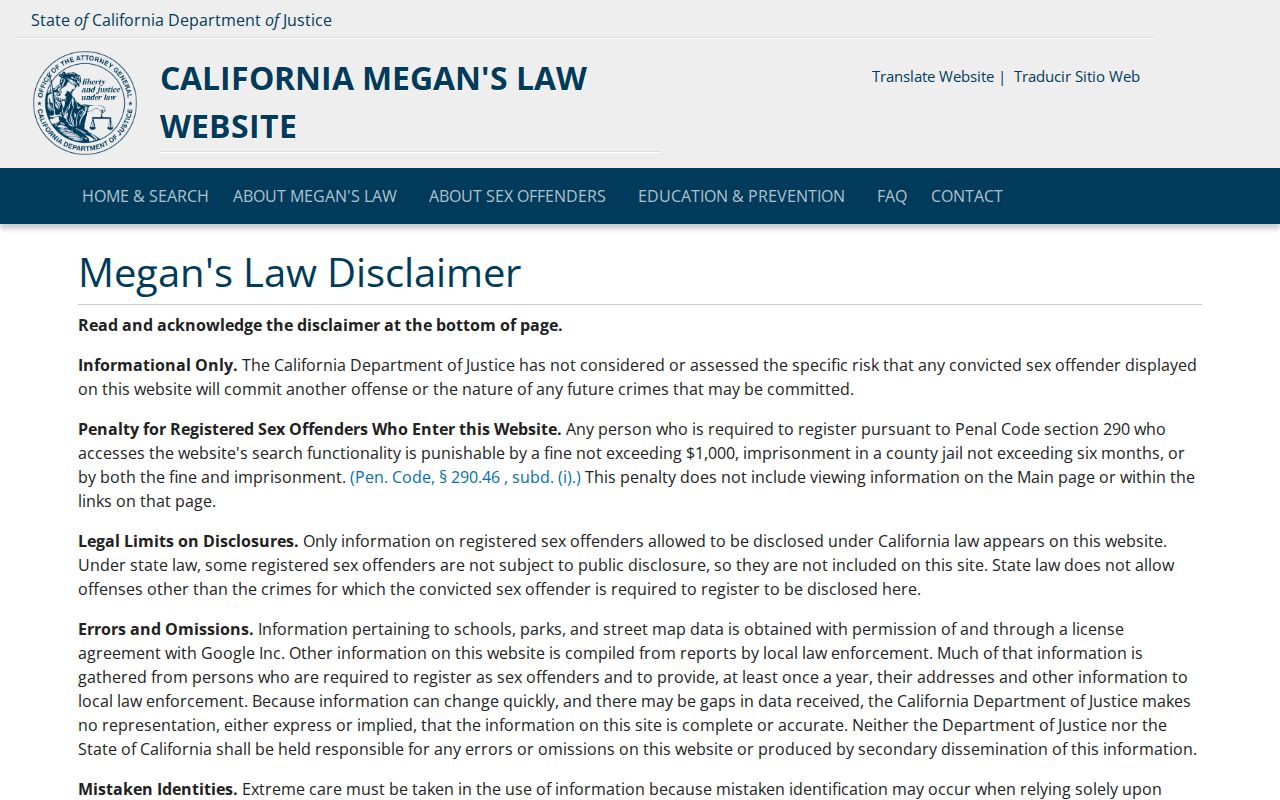
The La Quinta registry image belongs to a narrow safety source. It should not be treated as a complete La Quinta residents directory or a substitute for a resident lookup.
La Quinta Heirs, Obituaries, and Probate
An heir search in La Quinta often ends at probate or an obituary. Riverside probate filings can name a decedent, petitioner, personal representative, notices, and heirs. Some attachments stay confidential. Indio probate records are nearly all online from July 1994, with clerk, copy, and access rules that still apply to a La Quinta search.
Obituaries tell a different story. A La Quinta notice can list spouses, children, former cities, service locations, and a last known community. Families or newspapers supply the text. It is not a civil certificate. Pair it with a deed, vital record, census schedule, historical directory, or probate petition, since a legal description keeps an heir tied to the right parcel when several people share a name. The California Controller unclaimed-property search can add a reported La Quinta city or holder clue. A match still requires proof. It does not establish current La Quinta residence.
La Quinta unclaimed property is a name-match lead. It is not probate, deed, or vital evidence. Note: Probate and obituary clues should be corroborated before they connect an heir, decedent, and La Quinta parcel.
La Quinta Business Lookup Anchors
A La Quinta business name leaves several paper trails. California Secretary of State bizfile is the first stop. Riverside fictitious business name filings help too. Bizfile shows an entity number, status, formation jurisdiction, principal or mailing address, agent for service, and filed statement names. DCA Search narrows a license by type, board, number, name, city, or ZIP. Contractor, real-estate, medical, nursing, State Bar, alcohol, and food-facility records each have separate La Quinta custodians.
Anchor on the entity or license number. A filing may be stale. A business address is an affiliation, not proof of a home address. The California bizfile search and DCA license search work best when paired with a dated La Quinta record or known place.
Correct a La Quinta Resident Record
A downstream directory holds only copies. It cannot amend a La Quinta deed, court file, vital record, voter record, or license. Spot an error? Contact the office named on the record and ask for its correction, amendment, redaction, or appeal path. ACR says recorded public documents cannot be deleted just because someone wants invisibility. Remedies still cover true errors or unlawful details.
Safe at Home works differently. It gives a qualifying La Quinta participant a substitute address that shields the real one. State privacy law adds more. Covered consumers gain rights to know, delete with exceptions, correct, and opt out of sale or sharing by private data businesses, and the 2026 DROP platform offers one request route for registered data brokers. None of it changes official La Quinta county custody.
Lawful personal use. A La Quinta resident lookup is for personal, lawful research, family history, reconnecting, and civic understanding. Do not use location data to stalk, harass, intimidate, or harm anyone.
A La Quinta portal is not the only route. Try the custodian's counter, phone, mail form, archive referral, or a focused California Public Records Act request. CPRA rests on Government Code sections 7920.000 and following. Exemptions and direct-copy costs still apply. Note: A La Quinta correction request belongs with the source that created the field, because another office usually cannot amend its record.